

China Cleanroom Facility Design Requirements and Best Practices
2026-08-13
China’s cleanroom landscape doesn’t tolerate copy-paste designs. Between GB 50457, dynamic pass boxes, and regional inspectors who read pressure differentials like tea leaves, what looks right on paper often falls apart on site. Yet the best facilities share a common thread: they treat compliance as a baseline, not a finish line. Over years of executing pharmaceutical, biotech, and electronics projects, GENO Pharmatech has learned that true performance comes from sweating the details—airflow visualization, material outgassing, maintenance access, even the way operators move through gowning rooms. This post unpacks the design requirements and best practices that separate a cleanroom that merely passes inspection from one that stays stable, efficient, and audit-ready for years.
Decoding Cleanroom Classes Under China's GB Standards
China’s cleanroom classification often gets tangled up with older U.S. Federal Standard 209E labels like Class 100 or Class 10,000. The current GB/T 25915 series mirrors ISO 14644-1, so a room’s class is defined by the maximum permitted particle concentration per cubic meter at a specific particle size. For instance, an ISO Class 5 room under the GB standard allows no more than 3,520 particles ≥0.5 µm per cubic meter—roughly the same as the old Class 100 limit, but the GB method gives you more granularity across nine classes, from ISO Class 1 (cleanest) down to ISO Class 9.
What trips many people up is the way GB standards handle sampling and occupancy states. The class rating only applies when the room is in a defined state—usually at rest or operational—and you need to measure particles at more than one size threshold to confirm compliance. A room that looks spotless on a particle counter at 0.5 µm can fail at 0.1 µm if the air handling isn’t tuned correctly.
For practical use, semiconductor fabs and pharma filling lines typically chase ISO Class 5 or better under the GB umbrella, while less critical zones like packaging areas might settle for ISO Class 7 or 8. The trick is matching the class to the actual risk—overspecifying a cleanroom burns money on fan filter units and gowning, while underspecifying leads to product failures that are far costlier to trace.
Airflow Patterns That Prevent Contamination Hotspots
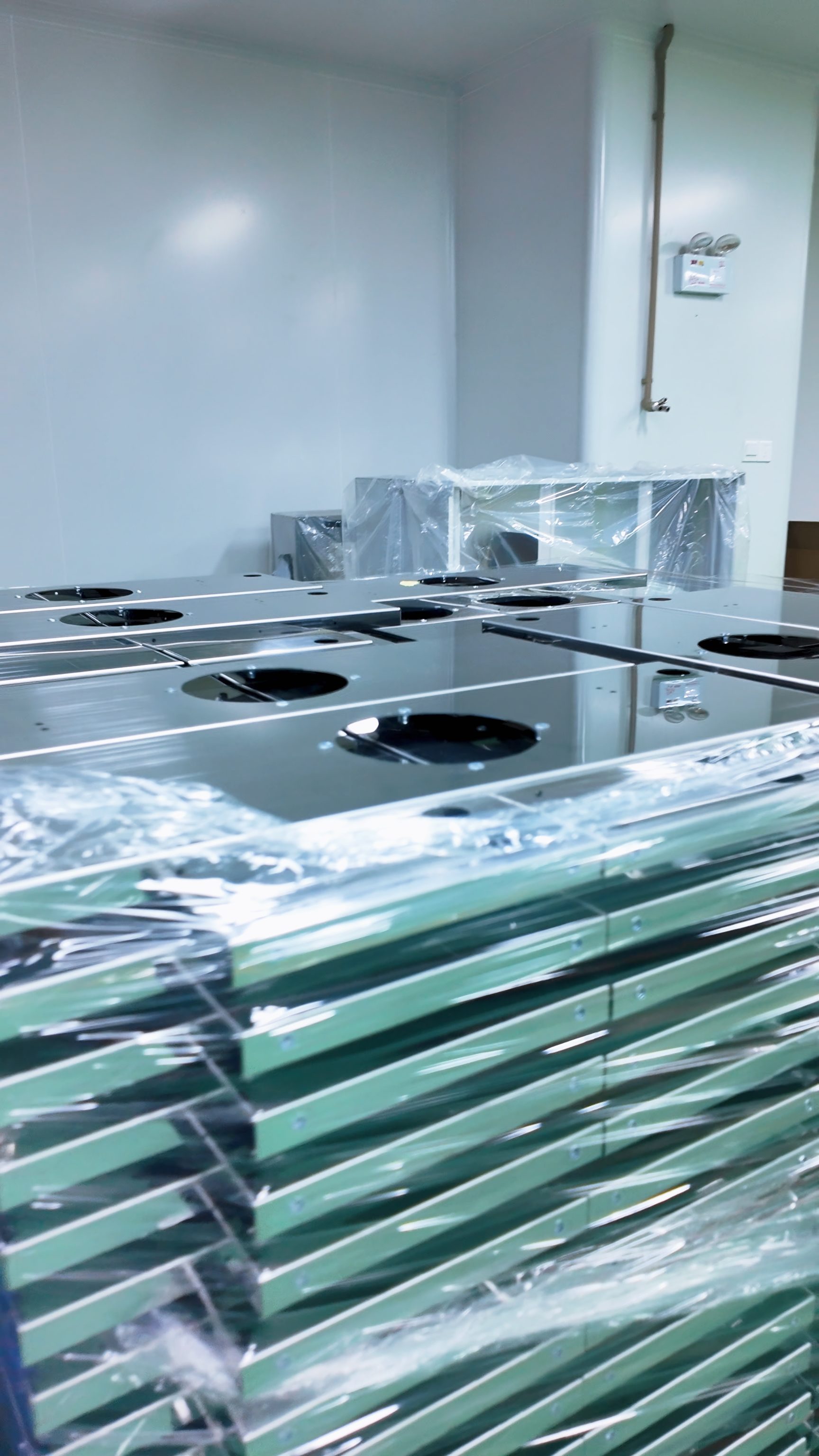
Unidirectional airflow is often treated as the default answer for clean zones, but the real difference shows up in how well the air manages to leave the room. Laminar flow only works if the return grilles sit low enough and close enough to the work surface to pull particles away before they linger. In practice, many so-called cleanrooms still develop dead corners near door swings or behind large equipment, because the supply air never actually reaches those spots. A better approach is to map the occupied zone first, then position low-wall returns so that the air sweeps across the critical area and exits without curling back on itself.
Pressure cascades matter more than most people admit. A positive-pressure suite can still contaminate itself if the air rushes toward an unplanned gap, like a pass-through that was never sealed properly or a cable tray that pierces the wall. Instead of relying on a single differential pressure number, it helps to walk the perimeter with a smoke pencil and look for reverse flow. The goal is not just to keep the room positive relative to the corridor, but to make sure every opening behaves like a one-way valve: clean to less clean, never the reverse.
Turbulence is not always the enemy. In some packaging or compounding areas, a fully mixed ventilation pattern with high air changes actually does a better job of diluting whatever gets released, as long as the supply and return locations don't create a short circuit. The trick is to avoid placing a supply diffuser directly above a return grille, because that just wastes clean air. Low returns on opposite walls, combined with ceiling supplies spaced well apart, can keep particles suspended long enough to be captured, rather than letting them settle onto product contact surfaces.
Managing Pressure Cascades for Cleanroom Integrity
Maintaining a proper pressure cascade is less about hitting a single setpoint and more about preserving a predictable airflow direction at every opening. Door undercuts, pass-throughs, and transfer hatches all act as intentional leaks; if the pressure differential across any of these points drops too low, unfiltered air can backflow into the cleanest zones. A common failure mode is not a complete loss of HVAC, but a slow drift caused by loading dock doors opening, exhaust fan speed changes, or even the gradual clogging of terminal HEPA filters.
The cascade itself should be mapped from the most critical area outward, with each zone stepping down roughly 10 to 15 pascals relative to the next less-clean space. This gradient allows continuous inward leakage from the clean core toward gowning areas, and from gowning areas toward uncontrolled corridors. Relying solely on a single pressure sensor at the cleanroom boundary creates blind spots; paired sensors across each dividing wall give a truer picture of what is actually happening at the door plane where contaminants would enter.
Operationally, alarms need to trigger on both low differential and rate-of-change, not just absolute pressure. A brief door opening will cause a transient dip, but if the recovery takes more than a few seconds or if the differential stays below the alarm threshold after the door closes, the cascade has effectively failed. Interlocking doors at airlocks helps limit simultaneous openings, but the interlock must be tuned to the HVAC response time—otherwise operators will learn to defeat it, and the cascade becomes a paperwork exercise instead of a physical barrier.
Selecting Surfaces and Materials That Stay Clean Longer
Instead of chasing stains after every meal, focus on how a surface handles contact with oil, water, and daily wear. Quartz countertops, for instance, resist staining far better than porous marble because the resin binder fills microscopic gaps. The same logic applies to flooring: glazed porcelain tiles shed spills quickly, while unsealed grout lines become a magnet for grime.
A smooth, closed-pore surface is usually easier to wipe down than a heavily textured one, even if the textured version hides dirt visually. High-gloss paint or polished concrete will show smudges faster, but they also let you remove them with a single pass. In contrast, matte finishes and deep grout lines trap particles and require scrubbing.
Low-maintenance doesn't stop at the first year. Consider how the material ages: some laminates look pristine initially but scratch or chip easily, creating tiny crevices where dirt collects. Solid surface or engineered stone can be refinished, while vinyl plank with a thick wear layer resists scuffs in high-traffic areas. The goal is to pick materials that keep their protective layer intact, because once that layer is compromised, cleaning becomes a losing battle.
HVAC Design for Energy Savings Without Purity Sacrifices
Traditional cleanroom HVAC treats airflow as the only lever for purity, locking facilities into constant-volume operation that wastes reheat energy. A better starting point is to decouple airborne cleanliness from fixed air change rates. Real-time particle counters and pressure differential sensors can drive variable air volume systems to deliver only the airflow needed to maintain ISO class limits at any given moment. When processes pause, the system trims supply and exhaust fans without allowing room pressure to collapse or temperature gradients to disturb unidirectional flow.
Energy savings also hide in the air handling sequence. Instead of cooling air to dew point and reheating it to supply conditions, run-around coils and desiccant wheels can manage latent load independently from sensible cooling. This avoids the classic reheat penalty while keeping relative humidity tight enough to prevent microbial growth and static discharge. For filtration, monitor HEPA pressure drop and replace filters based on loading curves rather than calendar intervals; early replacement wastes fan energy, while late replacement risks bypass leakage. These measures preserve purity because they respond to measured conditions instead of assumptions.
Navigating Chinese GMP Compliance and Validation Steps
Practical compliance with Chinese GMP rarely begins with the code itself—it begins with mapping how the 2010 revision and its appendices intersect with an existing quality system. Too many teams treat validation as a paperwork exercise, but inspectors from provincial drug administrations now expect the validation rationale to reflect actual process risk. For sterile lines, that means tying aseptic process simulations and environmental monitoring data directly to the sterile products appendix rather than reusing a generic global template.
A workable sequence is to draft a site-specific validation master plan, then execute equipment qualification under realistic worst-case conditions before moving into process performance qualification. Cleaning validation deserves particular attention because residue limits often need to align with Chinese Pharmacopoeia monographs and local toxicological data, not borrowed values. For computerized systems, treat electronic records and audit trails as part of the validation scope from the outset. The clearest contrast with some Western approaches is the expectation to demonstrate ongoing control through periodic review and change management, with data integrity evidence traceable to specific batches.
FAQ
China's cleanroom design commonly relies on GB 50073 and GB 50457, with cleanliness classes aligned to ISO 14644-1. Grades range from ISO 9 down to ISO 1, but pharmaceutical facilities more often use the Grade A through D system from Chinese GMP, while electronics plants may specify ISO 5 to ISO 8 depending on process sensitivity.
Higher-grade cleanrooms use unidirectional or laminar flow to sweep particles away from critical zones, while lower grades rely on turbulent mixing with defined air change rates. Chinese codes link air change frequency to cleanliness class, requiring more air changes for stricter grades, and designers must also account for ceiling coverage and return air placement to avoid dead spots.
Smooth, non-shedding and chemical-resistant surfaces are preferred. Walls and ceilings often use factory-finished sandwich panels with metal or PVC skins over a non-particulating core, while flooring commonly uses epoxy or polyurethane systems with integral coving to eliminate corners and make cleaning and disinfection easier.
Maintaining a positive pressure differential between cleaner and less clean adjacent zones is standard, usually in the range of 10 to 15 Pa. The cascade should be designed so air flows from the most critical areas outward, with pressure monitoring and alarms to alert staff when thresholds are breached.
Terminal HEPA or ULPA filters are installed for higher grades, with coarse and medium-efficiency pre-filters protecting them upstream. Variable-speed fans, heat recovery and demand-controlled airflow help reduce energy use while staying within GB 50189 limits. Proper filter sealing and airflow balancing are critical to avoid leakage and uneven air distribution.
Common tests include HEPA filter integrity scanning, airborne particle counting, airflow velocity and uniformity for unidirectional zones, room pressure differential verification, temperature and humidity checks, and recovery time after particle challenge. These should follow a written protocol and be repeated at defined intervals as part of ongoing requalification.
Frequent issues include underestimating the impact of outdoor air pollution on filter loading, providing too little space for maintenance access above ceilings, ignoring differences between national and local codes, and waiting too late to model airflow patterns. Early coordination with local authorities and experienced cleanroom contractors can prevent costly redesigns.
Conclusion
Designing cleanrooms for China requires more than meeting a particle count; it demands a careful reading of GB standards such as GB 50073 and the pharmaceutical-specific GB 50457 to map ISO classes onto local expectations. Airflow configuration then determines whether those classifications hold up in operation. Unidirectional flow works best for high-grade zones, while well-placed low-level returns in turbulent spaces prevent dead corners where contamination lingers. Pressure cascades must reinforce this logic, with the cleanest rooms kept at the highest positive pressure and door interlocks or active pressure monitoring to stop reversals during routine traffic. Surface choices also play a quiet but critical role: seamless epoxy or welded vinyl flooring, coved junctions, and non-shedding wall panels reduce particle traps and survive frequent wiping with aggressive disinfectants.
Energy efficiency need not undercut purity if the HVAC design treats airflow as a variable rather than a constant. Variable-speed fans, night setback modes, and demand-controlled filtration tuned to real occupancy or process schedules can cut power use without letting differential pressure drift. On the compliance side, Chinese GMP expectations push beyond construction: a structured validation path covering design qualification, installation qualification, operational qualification, and performance qualification is non-negotiable, followed by routine environmental monitoring and trending. Facilities that integrate class selection, airflow dynamics, pressure integrity, material durability, and commissioning early on tend to pass inspection with fewer deviations and operate with lower lifetime costs.
Contact Us
Contact Person: Amy Yang
Email: [email protected]
Tel/WhatsApp: 008619330882686
Website: https://www.genopharmatech.com/