
Sandpaper Supplier Essentials: Choosing Quality Abrasives for Perfect Finishes
2026-09-08
Every woodworker has felt the sting of a finish ruined by inconsistent grit or flimsy backing. So what should you actually look for in a sandpaper supplier? SHENZHEN SUN ABRASIVES has spent years helping workshops move past guesswork by focusing on three overlooked factors: abrasive grain quality, backing flexibility, and lot-to-lot consistency. The following guide breaks down these essentials so you can stop wasting money on subpar sheets and start achieving the smooth, professional finish your work demands.
The Grit Reality: Matching Numbers to Your Surface
Most people assume a higher grit number simply means a smoother finish, but that's only half the story. The number on the bag tells you how many abrasive particles fit through a standard sieve—so a 36-grit media has larger, more aggressive grains than a 120-grit. What often gets overlooked is the way that grit interacts with the hardness, profile, and contamination of your specific surface. If you blast a thin aluminum panel with coarse 24-grit coal slag, you'll deform it before you ever clean it. Conversely, using fine 80-grit glass bead on heavily rusted steel just polishes the rust instead of removing it.
Start by asking what the surface needs to become, not what the abrasive can do. For thick structural steel that will receive a heavy epoxy coating, a 30/60 mesh garnet or a 40-grit aluminum oxide leaves a deep angular profile that paint can bite into. On concrete, a 40/60 crushed glass at moderate pressure strips old sealers without gouging the slab. The same grit number can behave differently depending on whether it's a sharp crushed media or a rounded bead—shape matters as much as size. So matching numbers to your surface is less about memorizing charts and more about reading the surface's response.
Sometimes the right choice is a blend. Blasting an old cast-iron railing with a single 50-grit might be too slow on flat areas and too hot on ornate details. Mixing a batch of 60/80 garnet with a small percentage of 100-grit gives you enough cut to remove multiple paint layers while keeping the profile consistent for primer. Pay attention to how quickly the media breaks down, too. A softer recycled glass will fracture and round off after one pass, changing its effective grit from 36 to something closer to 80 on the second use. That drift can save you money or ruin your anchor pattern if you're not checking.
Backing Materials That Keep Their Cool Under Pressure
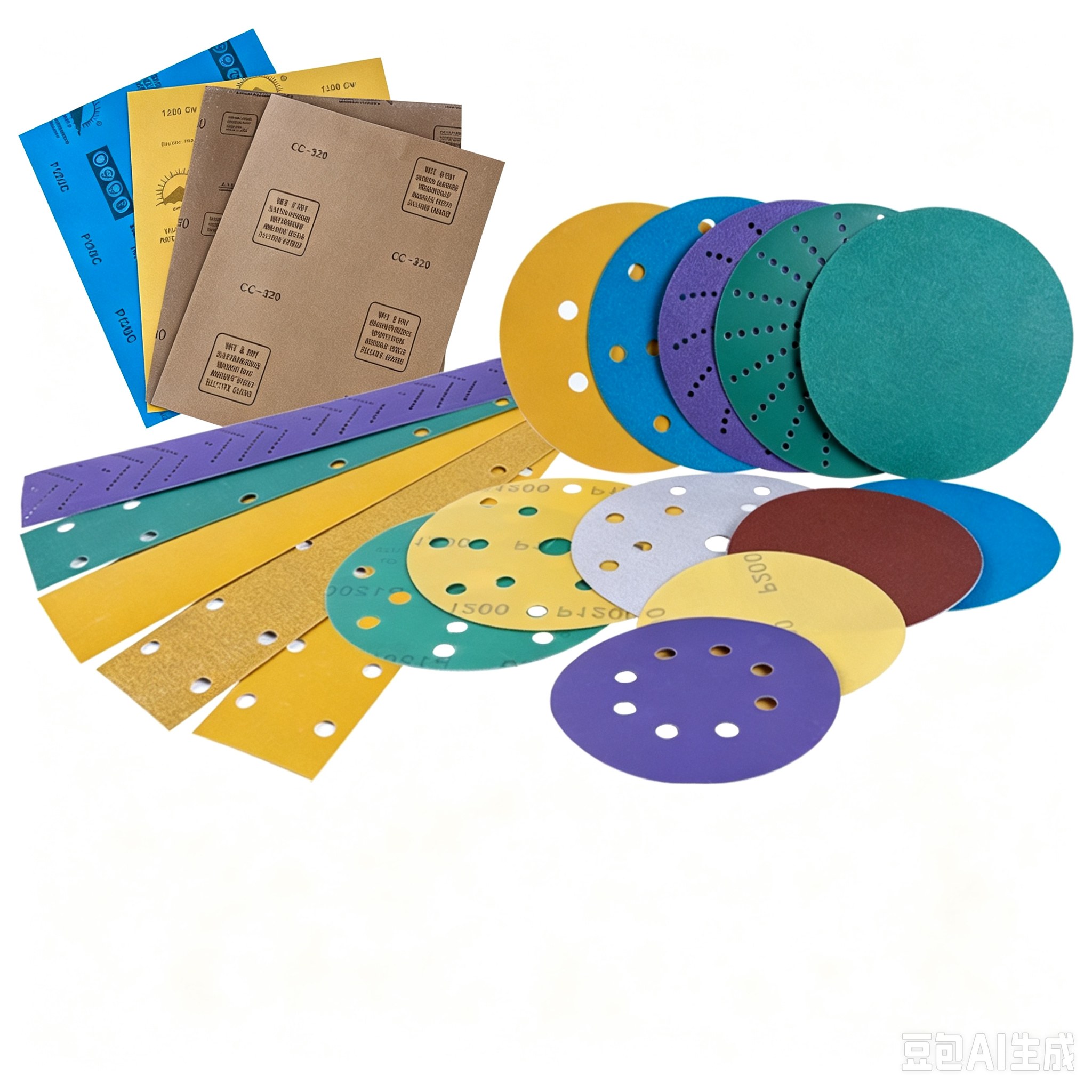
In heavy sanding or grinding, the backing isn't just along for the ride—it's the layer that takes the heat, literally. Cheap backings soften, stretch, or glaze over when friction spikes, but well-designed materials like heavyweight polyester film or blended cloth pull heat away from the abrasive side and hold their shape instead of buckling under load.
Some cloth backings use a tight weave that resists elongation while letting air move through the fibers just enough to shed heat. Vulcanized fiber and stiffer paper blends can also surprise you: they don't flex much, but that rigidity keeps the abrasive grit cutting straight rather than wobbling and generating extra friction. It's less about being cold to the touch and more about staying dimensionally stable when the temperature climbs.
If you're working long cycles on metal or hard alloys, pay attention to how a backing handles that thermal load. A backing that stays cool under pressure means fewer disc changes, less edge wear, and a finish that doesn't wander as the material heats up. It's one of those details that separates a frustrating job from a predictable one.
When Aluminum Oxide Isn't Enough: Specialty Abrasives Worth the Hunt
Standard aluminum oxide grit handles plenty of everyday grinding and sanding jobs, but it hits a wall when the workpiece gets stubborn. Hardened tool steels, carbides, ceramics, and even some exotics like titanium or nickel alloys will laugh off that familiar brown grit, leaving you with slow material removal, glazing, and a pile of wasted discs. That's when you need to step off the beaten path and track down abrasives made from something with sharper teeth and a meaner streak.
Zirconia alumina is often the first stop for anyone tired of watching aluminum oxide burnish instead of bite. Its self-sharpening crystalline structure keeps fracturing under pressure, constantly exposing fresh cutting edges, which makes it a favorite for aggressive grinding on stainless steel and high-tensile alloys. But push harder into the truly stubborn stuff—think tungsten carbide or glass-filled composites—and even zirconia starts to lose its nerve. That's where ceramic alumina earns its reputation. The micro-fracturing behavior is more controlled, the grains stay sharp longer, and the heat stays lower, so you can grind without cooking the temper out of your workpiece.
For the jobs that would eat ceramic for breakfast, there's a smaller crowd of specialty contenders worth knowing about. Diamond abrasives on rigid backings turn carbide, stone, and glass into powder without drama, though they demand respect—too much speed or dry running can burn them up fast. Cubic boron nitride, or CBN, fills a similar niche for hardened ferrous metals, cutting where diamond would chemically react and degrade. Then there are the oddballs like silicon carbide for non-ferrous metals and green grit for lapping. None of these are cheap or easy to find at the corner hardware store, but when the standard stuff just spins and shines the surface without cutting, hunting down a specialty abrasive is the only way to get the job done before the heat death of the universe.
Beyond the Sample Pack: Vetting Suppliers Who Deliver Consistency
A glossy sample pack can make almost any supplier look competent. The real test starts when you ask for the same thing again three months later and receive a slightly different shade, a thinner material, or a component that doesn't quite fit the way it used to. Consistency doesn't come from a one-off demo; it comes from a supplier's internal controls, raw material sourcing, and willingness to track and share batch-level data. If a vendor can't explain how they maintain tolerances from run to run, that sample is just a lucky accident.
Before signing anything, push past the sales pitch and ask how they handle repeat orders. Do they keep detailed production records for each SKU? Can they provide certificates of analysis or inspection reports for the last three shipments of a similar item? What happens when a raw material supplier changes or a machine gets recalibrated? You want to hear concrete answers about quarantine procedures, rework thresholds, and real rejection rates — not vague assurances about "quality first." A supplier that treats consistency as a measurable, documented process is far less likely to surprise you later.
One of the smartest moves is to start with a small trial run under your actual purchase order terms, then repeat that same order thirty or sixty days later without telling them it's a test. Compare the two deliveries side by side: dimensions, finish, packaging, even the placement of labels. If the second batch drifts, that's your signal to dig deeper or walk away. Consistency is not a feature you can verify from a sample room; it's a habit you have to observe across multiple production cycles.
The Hidden Costs of Cheap Sandpaper (And When to Spend More)
A pack of bargain sheets might cost half as much, but the real expense shows up in your time and finish quality. Low-grade abrasive sheds its grit quickly, so you end up pressing harder and going over the same spot multiple times. The backing also tears around orbital sander pads, and loose grains leave deep random scratches that telegraph through stain or clear coat.
Cheap sandpaper often uses a weak resin bond, which lets the grit pull away before it's dull. On resinous woods or painted surfaces, it loads up fast, turning a 20-minute job into an hour of peeling discs and cleaning pads. The extra friction builds heat, softening the adhesive and causing the disc to fly off at speed. Those small frustrations add up to wasted material when you have to re-cut a panel.
Pay extra for aluminum oxide or ceramic grit when you're working on hardwoods, metal, or any surface that will receive a clear finish. Premium paper keeps a consistent scratch pattern, which matters more than the initial price if you're leveling epoxy or polishing a car panel. Save the cheap stuff for rough drywall mud, stripping paint off outdoor furniture, or one-off tasks where the surface gets heavily primed afterward.
From Wood to Metal: Tailoring Your Abrasive Arsenal
Wood dust loads abrasives quickly, so open-coat papers with stearate coatings let you keep cutting without constantly clearing the grit. Switch to metal and that same soft, clog-resistant design becomes a liability: the coating can glaze under high heat and the open spaces waste abrasive on hard edges. Use closed-coat aluminum oxide or ceramic belts for ferrous metals, and reserve your open-coat stock for bare timber.
Pressure and speed need rethinking, too. On wood you can lean in a little and let the grit follow the grain; on steel, excessive pressure just fractures fresh abrasive and burns the surface. Keep your grinder or sander moving, back off the downforce, and let the tool's speed do the work. A lower RPM setting or variable-speed control helps when you're working thin sheet metal or heat-sensitive alloys.
Clean your work area between materials. Fine metal particles trapped in a pad or bench can scratch a softwood surface days later, and sawdust left on steel invites rust once humidity climbs. A quick vacuum, a dedicated set of discs for timber and another for steel, and a visual check for embedded grit prevent most cross-contamination headaches.
FAQ
A consistent abrasive shows even grain distribution with no bare patches or clumps. Bend the sheet and flex the backing; quality paper won't crack or shed grains immediately. On a test piece, the scratch pattern should be uniform and the cutting action stable, not fading sharply after the first few strokes. Weak bonding or uneven grain spacing causes erratic finishes no matter how fine the grit number claims to be.
Aluminum oxide is a solid all-rounder for wood and metal because it's tough and keeps cutting. Silicon carbide is sharper but more friable, so it works well on hardwoods, paint, glass, and non-ferrous metals. Ceramic abrasives shine under high pressure and heat, ideal for aggressive metal stock removal. Garnet is gentler and leaves a fine surface on bare wood but wears out faster. Choose based on the dominant workpiece, not just the cheapest option.
Not necessarily. Jumping from 80 to 220 grit leaves deep scratches that later stages can't fully erase. A perfect finish comes from a logical progression, usually staying within a 50% grit increase per step. Skipping too many levels forces the finer grit to remove too much material, causing uneven wear and a cloudy surface. Sometimes spending more time on a lower grit produces a flatter, more uniform base that makes the final finish easier.
Open-coat paper has only 50-70% grain coverage, leaving gaps for dust and swarf to escape. It resists clogging on soft woods, resinous timber, paint, and soft metals. Closed-coat has full grain coverage for faster cutting and a more even finish on hardwoods, metals, and other dense materials. If loading becomes a problem, open-coat is usually the fix, even if it cuts slightly slower.
Batch-to-batch consistency matters more than a low one-time quote. Ask about sample testing, custom slitting, minimum order flexibility, and whether they can provide technical data on backing, bond type, and grain. A supplier who asks about your application and offers alternatives is more valuable than one who only pushes stock numbers. Delivery reliability and realistic lead times also prevent production delays.
Wet sanding does extend life significantly when the paper is designed for it. Water cools the surface, reduces heat-related grain dulling, and flushes away swarf that would otherwise clog the coat. This keeps the cutting edge fresher for longer, especially with silicon carbide and waterproof backings. It also minimizes dust and improves the final surface clarity on paints and clear coats.
Run a controlled test on the same material with the same pressure and speed for a fixed number of strokes. Compare the amount of material removed, the evenness of the scratch pattern, and how much grain sheds. Flex and crease the backing to check for cracking. For wet use, soak a piece and see if the backing delaminates or the bond softens. A good sample will show steady cutting without sudden loss or patchy wear.
Backing stiffness and flexibility directly affect how pressure is transferred to the surface. Thin, flexible paper follows contours but can tear easily; heavy paper or cloth resists tearing but may create uneven pressure on delicate profiles. Film backing offers high flatness and consistent grain support for precision sanding. If the backing is too soft, grains can shift and dig in; too stiff, and you get chatter marks and uneven contact.
Conclusion
A flawless finish rarely hinges on technique alone—it starts with whether the abrasive in your hand matches the job. Most of us learn early that a 60-grit belt tears through old varnish while a 220-grit sheet kisses a final coat, but the real skill is reading the surface before reaching for a number. Hard resinous woods clog paper fast; soft metals smear if you linger. Beyond grit, the backing quietly decides how long that grit stays put: a stiff fiber disc survives edge work that would shred lightweight paper, while a flexible cloth belt wraps contours without cracking. And when standard aluminum oxide stalls on stainless steel or hardened alloys, the hunt for ceramic or zirconia blends stops being optional—those specialty abrasives cut cooler and keep their edges far longer, which matters when you're facing a stack of workpieces rather than a single test scrap.
Vetting a supplier, though, is about more than sample packs and spec sheets. Consistency is the thing you can't see until a batch fails, so it pays to ask how they source and test their lots, and whether they'll stand behind a run that breaks down early. Cheap sandpaper tells its own story: backing tears, grit sheds unevenly, heat builds until the resin lets go, and suddenly you've spent twice the time on one panel. Spending more upfront on abrasives that cut predictably often means fewer passes and less rework. What works on oak may be all wrong for aluminum, so a good supplier helps you tailor an arsenal—different backings, grit sequences, and abrasive types for wood, metal, paint, and composites—instead of pushing one all-purpose line. That kind of guidance is what turns a transaction into a working partnership.
Contact Us
Contact Person: Amanda Wang
Email: [email protected]
Tel/WhatsApp: +86-13602569854
Website: https://www.sunabrasives.com.cn