

Top Multi Core Fiber Fusion Splicer Models for High-Performance Networks
2026-08-15
Multi-core fiber is moving from research labs into production networks, yet splicing it properly remains a real challenge. Conventional splicers often struggle with core alignment, leading to higher loss and wasted deployment time. That’s why selecting a purpose-built model is critical for high-performance networks. DVP has been pushing the boundaries with automated multi-core alignment and low-loss splicing, but it’s not the only player worth watching. In this post, we’ll cut through the noise and look at the top fusion splicer models that actually deliver in the field.
The Alignment Challenge That Multi-Core Fibers Introduce
Multi-core fibers pack several independent cores into a single cladding, often with core pitches of 35–50 µm or less. This tight spacing turns what used to be a routine single-axis alignment into a six-degree-of-freedom problem. Each core must hit its corresponding port on a photonic integrated circuit or another fiber segment simultaneously, leaving almost no room for lateral drift, tilt, or rotational error. A shift of just a couple of microns can push one core into the cladding region of its target, while its neighbors may still show acceptable coupling—making it dangerously easy to miss partial misalignment during assembly.
Rotational alignment is particularly unforgiving. With multiple cores arranged in a ring or hexagonal pattern, an angular offset of even 0.5 degrees translates into a lateral displacement that grows with the radial distance from the fiber’s center. An outer core might drift by several microns while the central core stays nearly aligned, creating a deceptive failure mode where total power throughput looks fine but one or two channels are silently degraded. This is rarely an issue in single-core fibers, so many mature alignment jigs and fusion splicers simply lack the resolution or feedback to catch it.
Engineers often respond by adding fiducial markers, using side-view imaging, or switching to active alignment that monitors multiple cores in real time. But each choice brings trade-offs: markers can shift during cleaving, side-view systems struggle with depth perception, and active alignment loops become slow when they have to optimize across four, seven, or more cores simultaneously. The result is that multi-core fiber deployment depends less on the fiber itself and more on the patience and precision of the alignment process—a constraint that still shapes connector designs and field-splicing practices today.
Field-Tested Splicers That Handle Ribbon and Rollable Cores
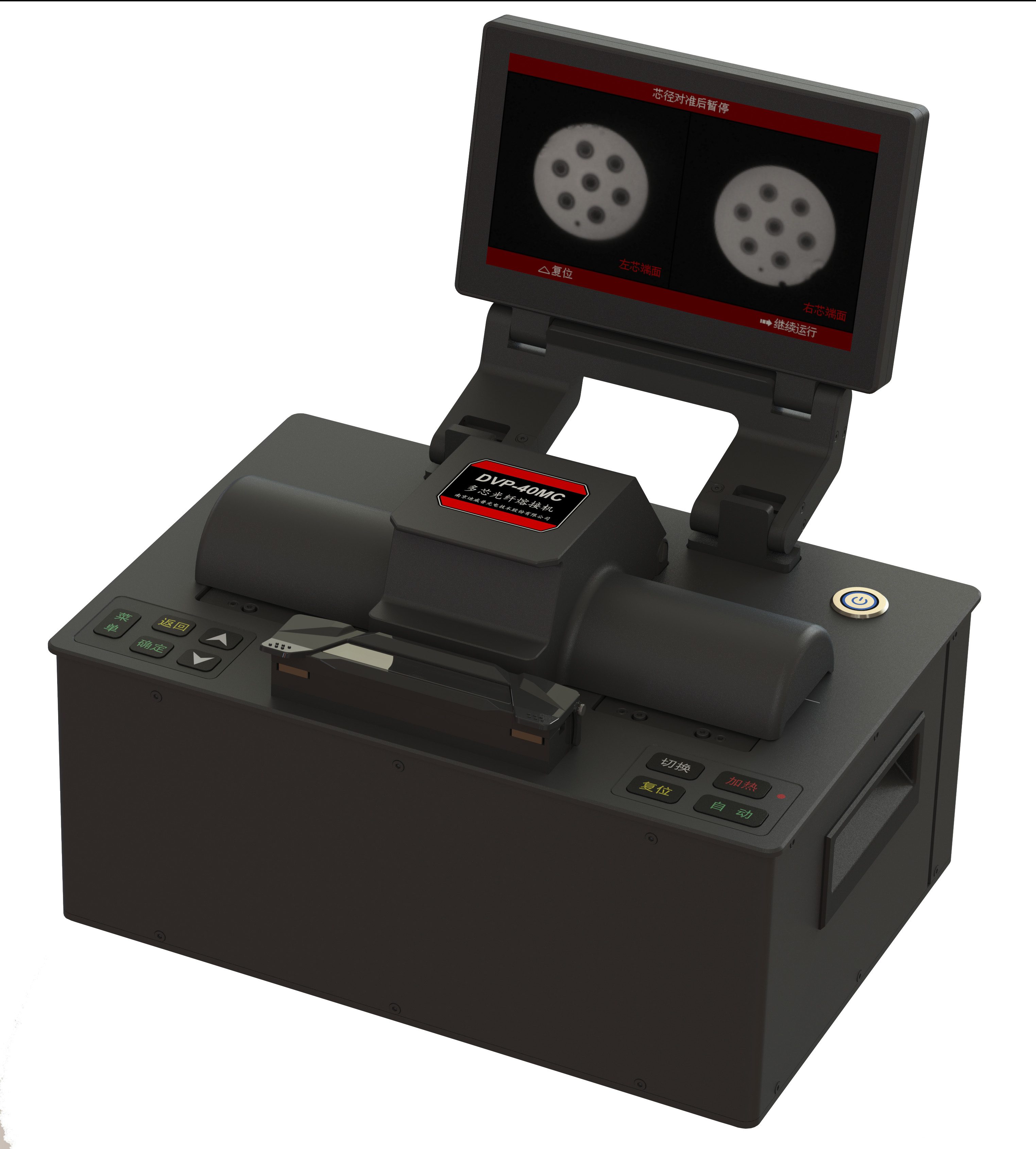
A splicer that only handles flat ribbon fiber becomes a liability the first time a crew opens a cable with rollable cores. These cores bend and wrap differently, so the fiber alignment and clamping mechanisms need to adapt on the fly. Field-tested units have gone through enough real splice cycles to know when to adjust clamp pressure, when to re-center the electrodes, and when to leave well enough alone. That kind of judgment gets baked into the firmware only after weeks of outdoor and vault work, not from a single lab demo.
On a job site, there is no luxury of swapping out holders for every cable type. Techs may hit a 12-fiber ribbon in one closure and a rollable 24-fiber bundle in the next. A splicer designed for both recognizes the core profile and sets the v-groove alignment without requiring a different set of guides. It also tolerates the usual dust, humidity, and temperature swings that come with splicing next to a manhole or up a pole. Machines that fail in those conditions get sent back; the ones that keep working are the ones crews request by name.
What separates a dependable field splicer from a bench unit is how it handles the transition between ribbon types. Rollable cores often sit tighter in the tray, so there is less room for error when loading fibers. The best units leave enough clearance for gloved hands, offer clear on-screen feedback when a ribbon is not seated properly, and still deliver splice loss numbers that hold up on an OTDR. After a few hundred splices across mixed cable plants, that reliability shows up as fewer rework tickets and a lot less time spent re-prepping fibers.
What High-Performance Networks Actually Demand from a Splicer
High-performance networks leave no room for sloppy splices. A splicer has to deliver consistently low loss across tight-buffer, bend-insensitive, and ribbon fibers alike. If alignment drifts between the first and fiftieth splice, downtime follows, and no carrier will tolerate a climbing loss budget in the middle of a rollout.
Field conditions matter just as much as lab specs. The unit needs to survive dust, temperature swings, and rushed technicians who may not have time for delicate handling. Core alignment should be automatic, but an experienced tech still wants the ability to override when a cleave angle sits at the edge of acceptable—otherwise good fiber gets wasted.
Throughput is another non-negotiable. Network builds and repairs don't pause for long recalibration cycles or vague error codes. Fast heat shrink ovens, quick boot times, and clear pass/fail feedback after each splice keep a crew moving instead of guessing. In the end, the splicer is only as good as the time it saves while maintaining a splice loss that won't come back to haunt the network later.
Side-by-Side: Compact Benchtop Units vs. All-Terrain Workhorses
Compact benchtop units are the quiet achievers of the lab, fitting neatly into corners where space is a premium. They handle everyday tasks with precision—weighing, mixing, small-scale synthesis—without demanding much in return except a power outlet and the occasional wipe-down. Their footprint is minimal, but so is their tolerance for heavy loads or harsh environments. You wouldn't ask one to churn through abrasive slurries or survive a dusty field deployment.
All-terrain workhorses, by contrast, are built for punishment. Think reinforced frames, sealed bearings, and motors that shrug off muddy boots and midday heat. These machines thrive in field stations, construction trailers, and remote research camps where reliability trumps elegance. They might not offer the finesse of a bench-top microcentrifuge, but they'll keep spinning when the generator hiccups and the dust rolls in. The trade-off is obvious: you give up bench space and pay extra for ruggedness you may never fully exploit indoors.
Choosing between them isn't about which is better—it's about where you actually work. A climate-controlled cleanroom rewards the compact unit's accuracy and silence. A mobile lab bouncing down gravel roads needs the workhorse's sealed guts and vibration tolerance. Most teams end up with one of each, because the moment you try to force a benchtop unit into the field, or drag a workhorse into a fume hood, you realize the real cost isn't the price tag—it's the downtime while you improvise a fix.
Calibration and Maintenance Habits That Extend Splicer Lifespan
Most splicer owners treat calibration as an occasional chore, but the difference between a machine that lasts three years and one that lasts eight often comes down to how regularly you check its alignment. A quick weekly pass with a reference fiber costs less than five minutes and catches drift before it turns into bad splices or damaged electrodes. The trick isn't just doing it—it's doing it under the same ambient conditions you actually work in, because temperature swings can mask real misalignment.
Cleaning habits matter more than most manuals admit. Instead of a rushed wipe before a job, get into the rhythm of inspecting the V-grooves and mirrors every single morning. A stray coating shard or a fingerprint on the lens will silently raise splice loss, and over time that forces the machine to compensate with higher arc power, which burns out electrodes faster. Use a blower first, then a lint-free swab with pure isopropyl alcohol—never a dry tissue, which just grinds debris in deeper.
Electrode care is where real lifespan gets won or lost. Rather than waiting for error messages, log your arc count and replace electrodes on a schedule tied to your typical fiber mix. A splicer doing lots of loose-tube single-mode work wears tips faster than one used mostly for drop cable. After swapping electrodes, run a stabilization arc five times and then recalibrate. Skipping that step is the silent killer of splicing consistency, and it usually shows up as a slow climb in estimated loss that everyone blames on the fiber.
Beyond Single-Core Thinking: Preparing Teams for Multi-Core Deployments
Most teams don't fail at multi-core because the code is wrong; they fail because their mental model still runs one instruction at a time. Single-core habits like assuming shared state is safe and ignoring memory visibility get exposed quickly when threads actually execute in parallel. Engineers need to unlearn sequential debugging and start reasoning about interleavings, cache contention, and happens-before relationships. That kind of thinking takes practice, not just reading a wiki page.
Preparation has to happen before the first production incident. Pair programming on concurrency-heavy paths, code reviews that explicitly look for data races and over-broad locking, and small internal tools that inject thread delays can reveal problems early. Teams that wait for a stall usually end up applying a mutex here and a sleep there instead of redesigning the work distribution.
Operations and QA belong in the transition too. Multi-core bugs are load-sensitive, so race conditions and thread starvation often stay hidden until scale. Run tests against realistic core counts, watch thread-pool saturation, and make sure ops can read scheduler and context-switch metrics. A team that shares this vocabulary will diagnose a hung process faster than one still trying to replay a single timeline.
FAQ
Several field teams now lean on the Fujikura FSM-100P+ and Sumitomo TYPE-201eM4 because they handle multi-core alignment with less manual adjustment, while the INNO View 12R keeps things lighter for outside plant work.
A multi-core unit has specialized core alignment and often a larger V-groove set to hold bundles or ribbonized multi-core fiber, so it can fuse several cores at once without losing the geometric relationship between cores, which matters for crosstalk and connector mating.
Yes, models like the Furukawa S179M and Fujikura 90S+ with multi-core fixtures have proven stable in outdoor conditions, though they require more careful cleaving and dust control than lab units.
They use dual-axis observation and active core alignment per core, combined with automatic calibration of the fusion arc, so each core within the same fiber can be optimized instead of applying one average setting.
The Sumitomo TYPE-72C+ with interchangeable fiber holders and the Fitel S185PM are often chosen because they let operators switch between 4-core, 7-core, and 8-core configurations without swapping the entire splicer head.
Look at the maximum fiber count per splice, cleaver compatibility with multi-core fiber, whether the software supports automatic core identification, and the availability of protective sleeves rated for the outer diameter of the specific multi-core cable.
In most cases no, because the imaging system and alignment algorithms are built around a single central core. Some manufacturers offer retrofit kits for limited ribbon work, but true multi-core fusion generally requires a purpose-built splicer with core-count aware software.
They reduce the number of individual splice operations on trunk cables and help preserve the spatial arrangement of cores, which lowers insertion loss variation and makes it easier to meet strict link budgets for 400G and 800G coherent links.
Conclusion
Multi-core fiber deployment has moved past the laboratory, and with it, the alignment problem has become the defining hurdle for fusion splicing. Unlike traditional single-core work, aligning multiple cores simultaneously demands sub-micron precision across rotational and axial axes, often requiring live core-to-core observation or specialized profile alignment. The top models now tackle this with automated multi-axis stages that lock onto all cores at once, dramatically cutting splice loss even on rollable ribbons or bend-insensitive multi-core configurations. Meanwhile, field-tested splicers are proving they can handle ribbonized and rollable core structures without sacrificing portability—a critical factor when high-performance networks roll out across varied environments, from dense urban ducts to long-haul routes.
What high-performance networks actually demand from a splicer goes beyond a single low-loss number. It means rapid thermal stripping, consistent arc calibration across temperature swings, and robust clamping that does not deform fragile cores. Comparing compact benchtop units with all-terrain workhorses reveals a clear trade-off: benchtop machines offer finer motor resolution and quiet operation for factory or data-center pre-termination, while rugged field units prioritize dust sealing, battery endurance, and glove-friendly controls. To extend lifespan, calibration and maintenance habits matter as much as the initial purchase—regular electrode cleaning, firmware updates, and verifying alignment after every few hundred splices keep drift in check. Finally, preparing crews for multi-core deployments requires shifting away from single-core thinking. Technicians must practice interpreting multi-core loss profiles, managing fan-out fixtures, and troubleshooting when one core aligns while another drifts. Teams that adopt this broader mindset get the most out of today’s leading multi-core splicers, turning a complex alignment challenge into a routine, repeatable field process.
Contact Us
Contact Person: Mr XU
Email: [email protected]
Tel/WhatsApp: 86-25-85582828
Website: https://www.dvp.cn/en/