
Why Is a Hospital Steel Building Becoming the Smarter Choice for Modern Healthcare Facilities?
2025-12-31
When I first started evaluating structural solutions for healthcare projects, I quickly realized how unforgiving hospital environments can be. Tight construction schedules, strict safety regulations, long-term operational costs, and future expansion pressures all collide in one place. That is where I began to notice how EIHE was gradually gaining recognition in medical construction discussions, especially around the concept of a Hospital Steel Building. Rather than flashy claims, what stood out was how well steel structures quietly solved real-world hospital challenges.
What Problems Do Traditional Hospital Buildings Struggle to Solve?
From my experience, many conventional hospital buildings face recurring issues that are difficult and expensive to fix later. These problems directly affect both patient care and hospital management.
- Limited flexibility for future department expansion or equipment upgrades
- Long construction cycles that delay hospital operation
- High maintenance costs over decades of use
- Difficulty meeting evolving seismic and safety standards
- Disruptions caused by renovation work in active medical environments
This is precisely why more project planners are reconsidering the Hospital Steel Building approach, especially for new hospitals, medical centers, and emergency facilities.
How Does a Hospital Steel Building Improve Construction Efficiency?
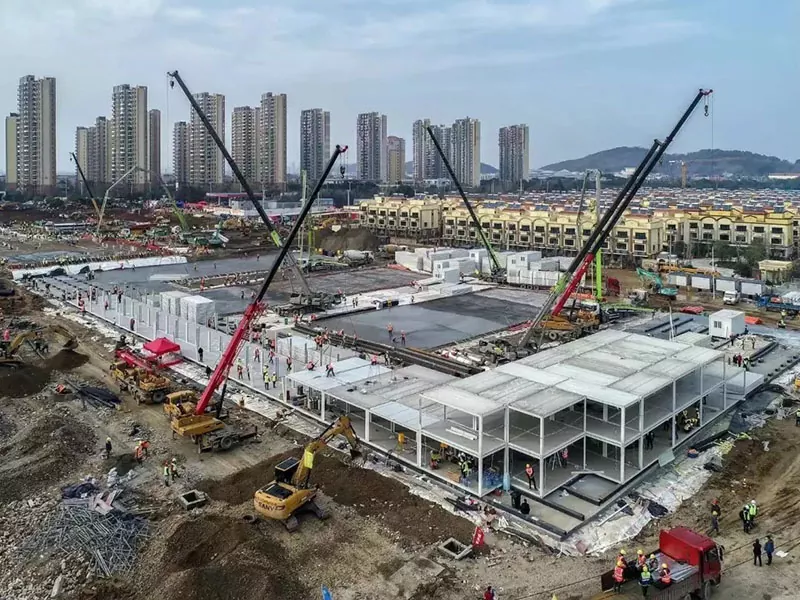
One of the first advantages I noticed is speed. Steel structures allow most components to be fabricated off-site, which dramatically reduces on-site construction time. For hospitals, this is not just about saving time—it is about opening doors to patients sooner.
| Construction Aspect | Traditional Structure | Hospital Steel Building |
|---|---|---|
| On-site construction time | Long and weather-dependent | Shorter and more predictable |
| Material precision | Variable | Factory-controlled accuracy |
| Project scheduling | Prone to delays | Highly controllable |
For healthcare investors and operators, faster delivery often translates into earlier revenue generation and reduced financing pressure.
Why Does Structural Flexibility Matter So Much in Hospitals?
Medical technology evolves rapidly. Imaging equipment grows larger, departments get reconfigured, and patient flow models change. A Hospital Steel Building provides wide-span spaces and modular layouts that make these changes easier to implement.
I have seen hospitals struggle with load-bearing walls that limit renovation options. Steel framing minimizes this issue, allowing internal spaces to be restructured without compromising structural integrity. This flexibility is one reason EIHE solutions are often discussed in long-term healthcare planning.
Can a Hospital Steel Building Meet Strict Safety and Compliance Standards?
Safety is non-negotiable in healthcare construction. Steel structures perform exceptionally well under seismic loads, fire protection systems, and strict engineering standards. When properly designed, a Hospital Steel Building can exceed local and international compliance requirements.
- Excellent seismic resistance for earthquake-prone regions
- Stable performance under heavy medical equipment loads
- Compatibility with advanced fireproofing systems
- Consistent quality through controlled fabrication
From a risk management perspective, this reliability reduces long-term operational uncertainty for hospital owners.
How Does a Hospital Steel Building Support Sustainable Healthcare Development?
Sustainability is no longer optional. Steel is recyclable, durable, and efficient when combined with modern insulation systems. In my view, a Hospital Steel Building aligns well with green building strategies by reducing material waste and supporting energy-efficient envelopes.
Additionally, future expansions can be planned without demolishing existing structures, which lowers environmental impact and overall lifecycle costs.
Is a Hospital Steel Building a Cost-Effective Long-Term Investment?
While initial budgeting often focuses on upfront costs, hospitals operate for decades. Steel buildings tend to offer lower maintenance demands, predictable performance, and easier upgrades. Over time, this can significantly reduce total ownership costs.
This long-term value proposition is why I see more healthcare developers asking detailed questions about Hospital Steel Building solutions rather than defaulting to traditional methods.
Are You Ready to Plan a Smarter Hospital Construction Project?
If you are evaluating new hospital construction or expansion options, now is the right time to rethink structural choices. A carefully designed steel solution can improve efficiency, safety, and adaptability for years to come.
If you would like to explore how EIHE can support your next Hospital Steel Building project, I strongly recommend reaching out for a tailored discussion. Contact us today to request technical details, design insights, or a customized proposal that fits your healthcare vision.